If you have ever paused mid-sentence wondering whether to write recurring or reoccurring, you are not alone. These two words look nearly identical, sound almost the same, and both describe something that happens more than once. Yet choosing the wrong one can quietly shift your meaning in ways you did not intend. Understanding recurring vs reoccurring is one of those small grammar victories that pays off every time you write a professional email, a medical record, a software report, or even a personal journal entry.
This guide breaks down the full picture so you never second-guess yourself again.
Decoding the Definitions: Recur vs. Reoccur
Before diving into recurring vs reoccurring, it helps to understand the base verbs that give these words their meaning.
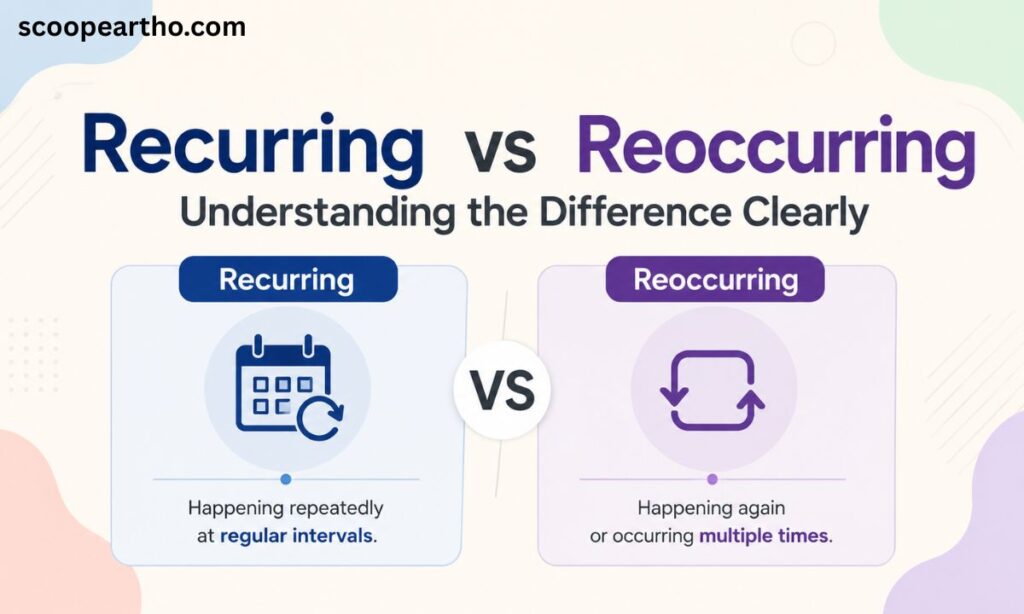
Recur means to happen repeatedly, often at regular or predictable intervals. There is an expectation of continuation built right into the word. When something recurs, it is not just happening again once. It is part of an ongoing pattern.
Reoccur means to happen again, simply and without any implication of regularity. The event took place before, and now it is taking place once more. That is all reoccur promises. No schedule, no pattern, no expectation of future repetition.
Adding -ing to each verb gives you the adjective and present participle forms most people get confused about:
| Word | Base Verb | Core Meaning |
| Recurring | Recur | Happening repeatedly, often on a schedule or pattern |
| Reoccurring | Reoccur | Happening again, but not necessarily more than once more |
This table captures the heart of recurring vs reoccurring at a glance. Regularity is the key dividing line.
Also read this article combating or combatting for more infomation
The Original Latin Roots and English Evolutions

Etymology is one of the best tools for understanding why two similar words carry different meanings. Both recur and reoccur trace back to the Latin verb currere, meaning “to run.”
Recur comes directly from the Classical Latin recurrere, meaning “to run back.” It entered English in the early 1500s and carried a natural sense of returning again and again, like a runner who laps a track. The word recourse shares this same Latin ancestor.
Reoccur arrived later, formed by English speakers in the 1700s who combined the familiar prefix re- with the verb occur. The Latin occurrere means “to run into” or “to meet,” which is where the English occur comes from. The first recorded use of reoccur dates to around 1734.
Both words literally mean “to run again,” but their separate historical journeys gave them subtly different connotations. Recur inherited a sense of rhythm and return, while reoccur simply captured the idea of something happening once more.
This is precisely why recurring vs reoccurring is worth understanding at the root level. The words are cousins with the same grandparent, but they grew up in slightly different households.
Breaking Down the Frequency Factor
The single most important concept in recurring vs reoccurring is frequency.
Think of it this way:
- Something that recurs happens over and over. It has a pattern. You can often predict it. Subscription payments recur monthly. Migraines recur in some patients every few weeks. Seasons recur every year.
- Something that reoccurs has happened before and is happening again, but it may never happen a third time. A plumbing problem that you fixed two years ago has now reoccurred. A disease symptom that was in remission has reoccurred. There is no implied schedule.
A helpful memory trick from the writing community: think of recurring as linked to the word repetitive, and reoccurring as linked to the word repeat. Something repetitive keeps going. Something that repeats may stop after one more time.
This frequency factor is what drives the correct usage of recurring vs reoccurring in professional and academic contexts.
Nuances of Usage in American English
In American English, recurring is by far the more common word. Grammar resources from Grammarly, Merriam-Webster, and the Microsoft 365 writing guide all confirm that recurring appears more frequently in edited prose, formal writing, and everyday speech.
Reoccurring is valid, but it carries a slight informal or narrative quality. You are more likely to encounter it in spoken conversation, blog posts, and casual emails than in contracts, academic journals, or technical documentation.
A few important nuances worth noting:
- In medical contexts, both recurrent and recurring are used for conditions that return, such as recurrent infections or recurring headaches. Recurrent is slightly more clinical in tone.
- In mathematics, a recurring decimal is one where a digit or group of digits repeats indefinitely, such as 0.333… This is always recurring, never reoccurring.
- In software and technology, developers typically use recurring for scheduled processes and reoccurring when describing a bug that appeared after being resolved.
Understanding these contextual shades makes the choice between recurring vs reoccurring feel natural rather than stressful.
When to Opt for ‘Recurring’ Over ‘Reoccurring’
Here is a practical checklist to guide your word choice:
Use recurring when:
- The event follows a regular schedule (weekly, monthly, annually)
- You expect the event to continue happening in the future
- The pattern has already been established over multiple occurrences
- You are writing in a formal, academic, or professional context
- You are describing a mathematical or financial concept (recurring revenue, recurring decimal)
Use reoccurring when:
- The event has happened before and is now happening again
- There is no established schedule or expectation of future repetition
- You want to emphasize the “happening again” aspect rather than a pattern
- The context is informal or conversational
If you can replace the word with repetitive or periodic and the sentence still makes sense, recurring is your word. If you can replace it with happening again and that captures your full meaning, reoccurring works fine.
Examples to Highlight Differences
Seeing recurring vs reoccurring in action is one of the fastest ways to internalize the distinction. Study these carefully:
Recurring in sentences:
- Her recurring nightmares kept her from getting a full night of sleep.
- The company set up a recurring payment plan for all annual subscribers.
- Water scarcity is a recurring theme in climate policy discussions.
- The doctor diagnosed him with a recurring ear infection that returned every winter.
- Birthdays are a recurring event that arrives like clockwork each year.
Reoccurring in sentences:
- The software bug had been fixed in March but reoccurred unexpectedly in October.
- We had hoped the flooding would not reoccur after the new drainage system was installed.
- The chest pain reoccurred two days after she was discharged from the hospital.
- The argument reoccurred at their next family gathering, catching everyone off guard.
Notice the difference in expectation. The recurring examples all suggest an established, ongoing pattern. The reoccurring examples describe a fresh instance of something that had happened before, with no guaranteed future repetition.
Linguistic Insights: Recurrence and Reoccurrence Compared
The noun forms of these words follow the same logic as their verb and adjective counterparts.
Recurrence refers to the state of happening repeatedly or periodically. It is a word commonly used in oncology (cancer recurrence), meteorology (weather pattern recurrence), and mathematics. When a doctor talks about the recurrence rate of a tumor, they mean how often and how predictably the cancer returns.
Reoccurrence refers simply to the act of something happening again. It is less common in formal writing and carries the same “one more time” implication as reoccur.
| Noun Form | Typical Context | Implication |
| Recurrence | Medical, scientific, financial | Pattern-based repetition |
| Reoccurrence | General, informal, narrative | A single instance of happening again |
One important note: recur does not have an adjective form that is widely accepted on its own, which is why recurring and recurrent both exist and are used interchangeably in many professional settings. Reoccur does not share this flexibility, making reoccurring its primary adjective form.
This is one of the more subtle linguistic points in the recurring vs reoccurring debate, and one that even experienced writers sometimes overlook.
Common Misconceptions and Clarifications
Misconception 1: They are perfect synonyms. While dictionaries like the Oxford English Dictionary do list reoccur as a synonym for recur, most grammar authorities agree that the words serve different communicative functions. Using them interchangeably risks imprecision, especially in formal writing.
Misconception 2: “Reoccurring” is not a real word. Some older dictionaries did not include reoccur as a standalone entry, which led to the myth that reoccurring is incorrect. Modern dictionaries, including Merriam-Webster, recognize it fully.
Misconception 3: “Recurring” always means regularly scheduled. Recurring does imply repetition, but not always a strict timetable. A recurring theme in a novel is not scheduled. A recurring argument in a relationship has no calendar. The word signals pattern and expectation more than clockwork precision.
Misconception 4: The two words are interchangeable in all situations. In casual speech, swapping them causes no confusion. In medical reports, contracts, technical writing, or academic papers, precision matters. The distinction in recurring vs reoccurring exists for good reason in those contexts.
Overlapping Usage in Everyday Communication

The honest reality of recurring vs reoccurring is that most people use these words interchangeably in day-to-day conversation, and that is mostly fine. Language is flexible, and meaning usually comes through clearly from context.
Where the overlap becomes a problem is in high-stakes writing. Consider these professional scenarios:
- A doctor who writes “reoccurring seizures” in a patient’s file may cause a reader to underestimate how frequent the seizures actually are.
- A software developer who uses “recurring bug” in a report is implying the bug is a known, established issue rather than a fresh surprise.
- A contract that mentions “recurring charges” signals a predictable, ongoing financial obligation.
When the stakes are low and the audience is general, the overlap in recurring vs reoccurring is harmless. When precision carries professional or legal weight, the distinction is worth getting right.
Quick Reference Section: Other Commonly Confused Words
If recurring vs reoccurring has you interested in similar pairs, here are other commonly confused words that follow the same logic:
| Confused Pair | Key Distinction |
| Affect vs Effect | Affect is usually the verb; effect is usually the noun |
| Imply vs Infer | The speaker implies; the listener infers |
| Comprise vs Compose | The whole comprises the parts; parts compose the whole |
| Continual vs Continuous | Continual means repeated with breaks; continuous means without interruption |
| Farther vs Further | Farther refers to physical distance; further to degree or extent |
Notice that continual vs continuous shares a similar logic to recurring vs reoccurring. Both pairs hinge on the question of regularity versus simple repetition.
Case Studies and Real-Life Applications
Case Study 1: Corporate Meetings
A project manager is writing the weekly team agenda. She wants to describe meetings that happen every Monday without fail.
She writes: “Monday standups are recurring meetings that all team members must attend.”
This is the correct choice. The meetings follow a fixed, predictable schedule with an ongoing expectation. If she had used reoccurring, the sentence would subtly suggest the meetings are sporadic or resuming after a gap rather than part of a reliable weekly cadence.
If, however, she is informing the team that an ad-hoc meeting from last quarter is happening again for a second time, she might write: “The strategy alignment session will be reoccurring next Thursday.”
This captures the one-more-time nature of the event without implying it will become a weekly fixture.
Case Study 2: Software Bugs
A QA engineer writes a ticket in the bug tracking system. A payment gateway issue that was closed three months ago has just surfaced again in production.
He writes: “Payment timeout error has reoccurred in the production environment following the v3.2 release.”
This is precisely right. The bug is not a known, patterned problem. It was closed and has now shown up again unexpectedly. Using recurring here would falsely imply the engineering team considers this a pattern they regularly deal with.
Once the bug appears a fifth or sixth time across multiple releases, the language shifts. The engineer might now write: “This is a recurring payment timeout issue that resurfaces with each major release cycle.”
Case Study 3: Personal Life
A person keeping a health journal notices that they get a tension headache every Sunday evening after a stressful workweek.
They write: “I have been experiencing recurring Sunday headaches for the past three months. I need to talk to my doctor about this pattern.”
Recurring is right here. There is a clear weekly pattern tied to a predictable trigger.
But if a headache they had last year during a particularly stressful period shows up again after several headache-free months, they might write: “My stress headache has reoccurred after what I thought was a long period of recovery.”
The contrast in both personal and professional contexts shows why recurring vs reoccurring is worth learning.
Two-Minute English Tip
Here is the fastest way to remember the recurring vs reoccurring distinction and never forget it:
Think: R in Recurring = Routine.
If the event is part of a routine, a schedule, or a predictable pattern, recurring is your word.
If it is simply happening again without a set routine, reoccurring covers it.
One more anchor: recur is older (1500s), more established, and more widely used. When in doubt, default to recurring. It fits more situations, sounds more polished in formal writing, and will never be wrong in contexts where either word could technically apply.
Conclusion
The debate over recurring vs reoccurring comes down to one central idea: regularity. Recurring signals a pattern, a schedule, and an expectation that something will keep happening. Reoccurring simply says that something has happened again, without promising it will happen a third time.
Both words are real, both are useful, and both appear in everyday writing. The difference between them is subtle but meaningful in contexts where precision matters most. Whether you are writing a medical note, drafting a contract, filing a software report, or explaining a dream to a friend, knowing the right word makes your communication cleaner and more credible.
Use this guide as your reference. The next time recurring vs reoccurring comes up, you will know exactly which one belongs in your sentence.

A passionate grammar enthusiast with over 4 years of experience in English writing and content creation. Through Scoopeartho, he simplifies grammar rules and common English mistakes with clear and easy-to-understand guides for readers worldwide.