“I look forward to working with you” is one of the most common closing lines in business emails. It is polite, safe, and easy to understand. But when you use the same sentence in every email, cover letter, or LinkedIn message, it starts to feel stale.
The good news is that English gives you dozens of ways to express the same enthusiasm without repeating yourself. Whether you are emailing a new client, welcoming a teammate, or closing out a job interview, the right alternative can make your message sound warmer, more specific, and more memorable.
This guide breaks down what the phrase actually means, when it fits best, and thirty natural alternatives you can start using today, complete with tone notes and example sentences.
What Does “I Look Forward to Working With You” Mean?
At its core, this phrase signals anticipation. It tells the reader that you are genuinely pleased about an upcoming collaboration, project, or working relationship. It is not just a formality; it communicates optimism, respect, and readiness to contribute.
People typically use it to:
- Show enthusiasm about a new job, project, or partnership
- Close a professional email on a positive note
- Reassure a client or colleague that you value the relationship
- Signal confidence and interest after a job interview
In short, the phrase blends courtesy with genuine intent. It tells the other person, “I’m glad this is happening, and I’m ready to put in the effort.”
When to Use “I Look Forward to Working With You”
This phrase works best in situations where you want to end on a hopeful, forward-looking note. Common scenarios include:
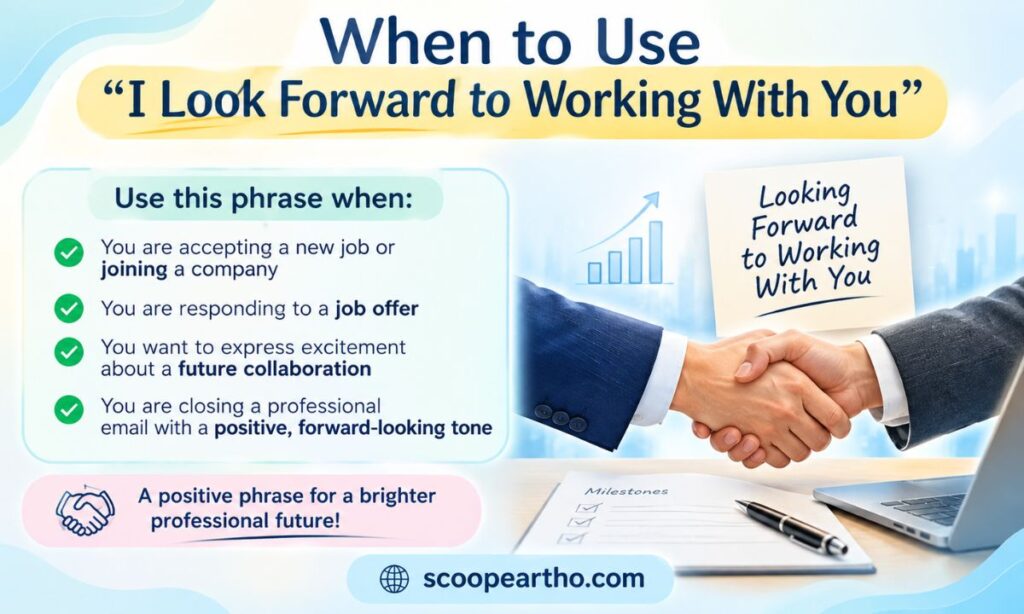
- Job acceptance emails — confirming you’re excited to start a new role
- New client introductions — setting a positive tone for a fresh business relationship
- Team onboarding messages — welcoming a new colleague or being welcomed yourself
- Post-interview follow-ups — reinforcing your interest in the position
- Project kickoff emails — signaling readiness before work begins
- Networking follow-ups — closing a conversation with a potential collaborator
It fits almost any professional context, which is exactly why so many people overuse it. Once you recognize these situations, you can start swapping in a fresher alternative that still hits the same note of professionalism.
Is It Professional/Polite to Say “I Look Forward to Working With You”?
Yes, it is both professional and polite. The phrase carries a respectful, courteous tone that suits formal business writing, job applications, and client communication. It does not overstep any boundaries and works well with people you have never met as well as long-term colleagues.
That said, “professional” does not mean “the only option.” Using varied language shows stronger communication skills and helps your message stand out in a crowded inbox. A recruiter or client who reads the same sign-off from every applicant is far more likely to remember the one that sounded genuine and specific.
Synonyms for “I Look Forward to Working With You”
Below are thirty alternatives, each with a short explanation of its tone and a sample sentence you can adapt for your own emails or messages.
| # | Phrase | Best For |
| 1 | Excited to Collaborate | New partnerships, creative projects |
| 2 | Can’t Wait to Work Together | Casual, friendly emails |
| 3 | Looking Forward to Our Collaboration | Formal client communication |
| 4 | Eager to Join Forces | Team mergers, joint ventures |
| 5 | Anticipating Our Work Together | Formal business tone |
| 6 | Thrilled About Our Partnership | Long-term business relationships |
| 7 | Ready to Get Started | Project kickoffs |
| 8 | Looking Ahead to Our Project | Specific project-based work |
| 9 | Excited for What’s Ahead | General optimism |
| 10 | Keen to Work With You | British/formal English tone |
1. Excited to Collaborate
This alternative feels fresh and energetic while staying professional. It works well when reaching out to a new colleague, freelancer, or cross-functional team.
Example: “I’m excited to collaborate on this campaign and see what we can build together.”
2. Can’t Wait to Work Together
A more casual, warm option best suited for informal workplaces or messages to people you already know a little.
Example: “Can’t wait to work together, this project sounds like a great fit for both our teams.”
3. Looking Forward to Our Collaboration
A formal, polished phrase that suits client emails, proposals, and official business correspondence.
Example: “Looking forward to our collaboration on the upcoming product launch.”
4. Eager to Join Forces
This phrase suggests combining strengths, making it ideal for partnerships, mergers, or joint projects between two teams.
Example: “We’re eager to join forces with your team to deliver the best possible outcome.”
5. Anticipating Our Work Together
A slightly more formal, reflective tone that works well in cover letters or executive-level correspondence.
Example: “I am anticipating our work together with genuine enthusiasm.”
6. Thrilled About Our Partnership
Best used when the relationship is more strategic than transactional, such as a long-term vendor or business alliance.
Example: “We are thrilled about our partnership and confident it will drive strong results.”
7. Ready to Get Started
A direct, action-oriented phrase that works well for project kickoffs where momentum matters more than sentiment.
Example: “I’ve reviewed the brief and I’m ready to get started whenever you are.”
8. Looking Ahead to Our Project
Useful when you want to reference a specific, named project rather than the relationship in general.
Example: “Looking ahead to our project, I think the timeline you proposed works well.”
9. Excited for What’s Ahead
A slightly broader, optimistic phrase that suits new job announcements or team introductions.
Example: “I’m excited for what’s ahead as I join the marketing team next month.”
READ MORE: 30 Other Ways to Say “Happy Birthday in Advance” (With Examples)
10. Keen to Work With You
Common in British and Australian business English, this phrase carries the same weight as “excited” but with a more understated tone.
Example: “I’m keen to work with you on refining the proposal before Friday.”
11. Can’t Wait to Start
A short, energetic phrase that fits informal emails, Slack messages, or texts to a new hire or collaborator.
Example: “Can’t wait to start, I’ve already got a few ideas to share.”
12. Enthusiastic About Our Collaboration

A formal alternative that pairs well with cover letters and detailed business proposals.
Example: “I remain enthusiastic about our collaboration and the goals we discussed.”
13. Looking Forward to Contributing
This phrase shifts the focus from the relationship to your own input, which works well in job acceptance emails.
Example: “I’m looking forward to contributing my skills to the design team.”
14. Excited to Contribute
A close variation of the above, slightly more casual and personal.
Example: “Excited to contribute to such an innovative project from day one.”
15. Eager to Begin
A concise, formal option that suits onboarding emails or confirmations of a start date.
Example: “I am eager to begin and appreciate the warm welcome from the team.”
16. Can’t Wait to Team Up
A playful, friendly phrase suited to informal or creative industries.
Example: “Can’t wait to team up with such a talented group of designers.”
17. Excited About This Opportunity
Works especially well in interview follow-ups or offer acceptance emails, since it references the opportunity itself.
Example: “I’m excited about this opportunity and grateful for your confidence in me.”
18. Looking Forward to Joining Forces
Similar to “eager to join forces,” but slightly softer and better suited for closing lines in emails.
Example: “Looking forward to joining forces on this year’s biggest initiative.”
19. Anticipating a Great Partnership
A confident, forward-looking phrase ideal for new client relationships or vendor agreements.
Example: “We’re anticipating a great partnership as we move into the next phase.”
20. Ready to Collaborate
A neutral, professional phrase that works in almost any business context without sounding overly emotional.
Example: “I’ve cleared my schedule and I’m ready to collaborate starting Monday.”
21. Looking Forward to Our Work Together
A near-direct swap for the original phrase, useful when you want minimal change but slightly fresher wording.
Example: “Looking forward to our work together over the coming quarter.”
22. Excited to Be Part of This Team
Best for new hires introducing themselves to colleagues for the first time.
Example: “Excited to be part of this team and to learn from all of you.”
23. Thrilled to Work With You
A warmer, more personal option suited for smaller teams or close working relationships.
Example: “Thrilled to work with you again after our last successful project.”
24. Looking Forward to Achieving Together
A results-focused phrase that works well when goals or KPIs are part of the conversation.
Example: “Looking forward to achieving great results together this year.”
25. Can’t Wait to Collaborate With You
A more specific, energetic version of “can’t wait to work together,” ideal for one-on-one professional emails.
Example: “Can’t wait to collaborate with you on the new brand strategy.”
26. Eager to Make Progress Together
Useful for ongoing projects where momentum and forward motion are the focus.
Example: “I’m eager to make progress together now that the contract is signed.”
27. Excited About Our Teamwork
A friendly, team-oriented phrase suited to internal company communication.
Example: “Excited about our teamwork as we tackle this quarter’s targets.”
28. Looking Forward to Making an Impact
Best for roles where influence, results, or change are central to the job.
Example: “I’m looking forward to making an impact in my first few months here.”
29. Can’t Wait to Get Started With You
A personal, upbeat closing line that fits both formal and semi-formal emails.
Example: “Can’t wait to get started with you on this exciting new venture.”
30. Thrilled About the Opportunity to Work Together
A longer, more formal phrase that suits detailed cover letters or proposal emails.
Example: “I’m thrilled about the opportunity to work together and contribute to your team’s success.”
Conclusion
“I look forward to working with you” is a dependable, professional phrase, but it is far from the only option. Swapping it for one of the thirty alternatives above helps your emails, cover letters, and messages feel more personal and less like a template.
The key is matching the tone of the phrase to your audience and context. Use formal options like “anticipating our work together” for executives and clients, and save casual lines like “can’t wait to team up” for colleagues you already know well. Either way, a small change in wording can leave a much stronger impression.

A passionate grammar enthusiast with over 4 years of experience in English writing and content creation. Through Scoopeartho, he simplifies grammar rules and common English mistakes with clear and easy-to-understand guides for readers worldwide.