
Saying “well noted” over and over in emails can start to feel flat. It gets the job done, but it doesn’t always show warmth, engagement, or personality. If you want your replies to sound more thoughtful without losing professionalism, this guide gives you 30 polished alternatives, complete with meanings and example sentences, so you always have the right words on hand.
What Does “Well Noted” Mean?
“Well noted” is a short, formal way of confirming that you have received, read, and understood a piece of information. It’s often used in workplace emails to acknowledge instructions, feedback, updates, or requests without necessarily agreeing or disagreeing with them.
In simple terms, it tells the sender: “I saw your message, I understood it, and I’ll keep it in mind.” It doesn’t promise action on its own, which is why many professionals pair it with a follow-up line about next steps.
When to Use “Well Noted”
“Well noted” fits best in situations where you need a quick, professional confirmation. Common examples include:
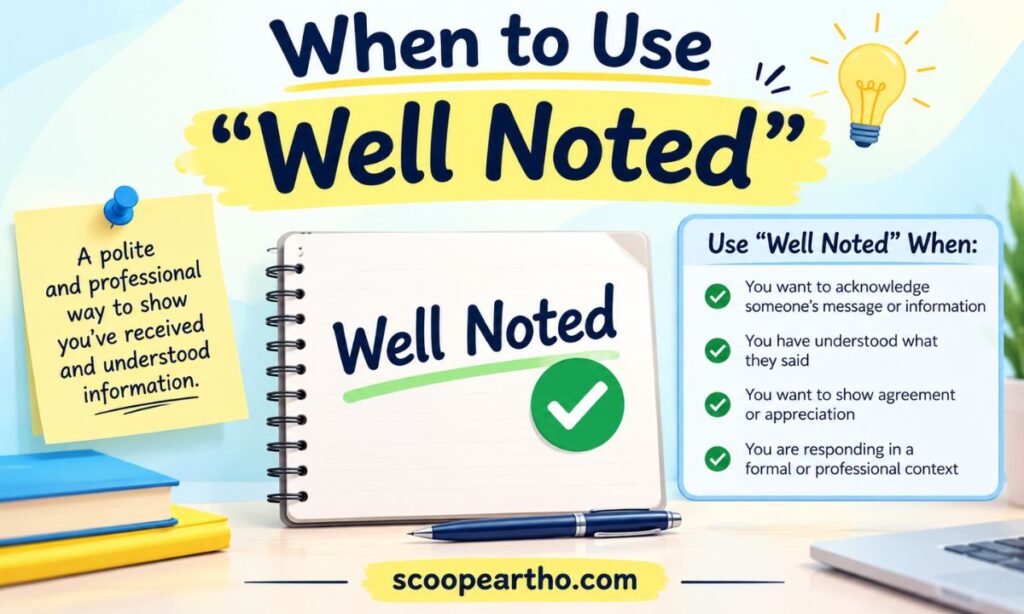
- Acknowledging a new deadline or schedule change
- Confirming receipt of instructions from a manager
- Responding to policy updates or internal announcements
- Accepting feedback on a report, project, or draft
- Replying to a client who has shared new requirements
It’s less suitable for casual chats with close colleagues, emotional conversations, or situations where the sender is expecting a warmer, more personal reply.
Is It Professional or Polite to Say “Well Noted”?
Yes, “well noted” is grammatically correct and considered professional in most business contexts. It works well in formal emails, especially with senior colleagues, clients, or supervisors.
That said, using it too often can make your writing sound repetitive, robotic, or emotionally distant. Communication experts generally recommend rotating your acknowledgment phrases so your replies feel more genuine and less like a copy-paste response. That’s exactly why having a list of alternatives is useful, so your tone stays fresh across different situations and relationships.
Synonyms For “Well Noted”
Below are 30 professional and polite alternatives to “well noted,” organized with their meaning, best use case, and an example sentence for each.
| # | Phrase | Tone |
| 1 | Acknowledged | Formal |
| 2 | Noted With Thanks | Formal, warm |
| 3 | Understood | Neutral |
| 4 | Got It | Informal |
| 5 | Duly Noted | Formal |
| 6 | Taken On Board | Semi-formal |
| 7 | I Understand | Neutral |
| 8 | Received With Thanks | Formal |
| 9 | Point Taken | Semi-formal |
| 10 | Message Received | Neutral |
| 11 | I’ve Noted This | Neutral |
| 12 | Thanks for Letting Me Know | Friendly |
| 13 | I’ll Keep This in Mind | Neutral |
| 14 | Noted and Appreciated | Warm |
| 15 | Consider It Noted | Confident |
| 16 | I’ve Taken Note | Neutral |
| 17 | This Is Clear | Neutral |
| 18 | I Hear You | Empathetic |
| 19 | Understood and Noted | Formal |
| 20 | All Clear | Casual |
| 21 | I’ve Got This | Confident |
| 22 | Clear on This | Neutral |
| 23 | I Acknowledge This | Formal |
| 24 | Noted for Future Reference | Formal |
| 25 | I Appreciate the Update | Warm |
| 26 | All Set | Casual |
| 27 | I’m Aware Now | Neutral |
| 28 | Thanks for the Heads-Up | Friendly |
| 29 | I’ve Made a Note | Neutral |
| 30 | Thanks, Noted | Friendly, brief |
Now let’s look at each phrase in more detail, along with when to use it and how it sounds in a real message.
1. Acknowledged
Meaning: A single-word confirmation that you’ve received and understood the information.
When to use it: Best for formal emails to managers, clients, or official correspondence.
Example: “Acknowledged. I’ll update the report by Friday.”
2. Noted With Thanks
Meaning: Combines acknowledgment with gratitude, making the reply feel more considerate.
When to use it: Useful when someone shares helpful information or feedback.
Example: “Noted with thanks. I’ll factor this into the next draft.”
3. Understood
Meaning: Confirms comprehension of instructions or explanations, though it can sound slightly firm.
When to use it: Ideal for clear, direct professional discussions.
Example: “Understood. I’ll proceed as instructed.”
READ MORE: 30 Other Ways to Say “I Hope You Are Doing Well” (With Examples)
4. Got It
Meaning: A casual way of showing you’ve fully grasped a piece of information.
When to use it: Suitable for informal chats with colleagues you know well.
Example: “Got it, thanks for flagging that.”
5. Duly Noted
Meaning: A formal, slightly official-sounding way of confirming acknowledgment.
When to use it: Common in corporate emails, instructions, or authority-driven communication.
Example: “Duly noted. This will be reflected in our next update.”
6. Taken On Board
Meaning: Suggests that the feedback or suggestion will genuinely influence future decisions.
When to use it: Great for responding to feedback or new ideas from a team member.
Example: “That’s taken on board. We’ll adjust the plan accordingly.”
7. I Understand
Meaning: A warmer, more conversational version of “understood.”
When to use it: Works well in both professional and semi-formal exchanges.
Example: “I understand. I’ll make sure this is included in the summary.”
8. Received With Thanks
Meaning: Confirms that a document, file, or message has arrived and is appreciated.
When to use it: Useful for acknowledging attachments, reports, or shared files.
Example: “Received with thanks. I’ll review it this afternoon.”
9. Point Taken
Meaning: Shows you’ve understood someone’s argument or concern, often after a correction.
When to use it: Fits situations involving feedback, criticism, or a differing opinion.
Example: “Point taken, I’ll revise the approach.”
10. Message Received
Meaning: A straightforward confirmation that the communication has arrived and been read.
When to use it: Suitable for both formal and casual workplace messaging.
Example: “Message received. I’ll get back to you shortly.”
11. I’ve Noted This
Meaning: A personal, first-person way of confirming you’ve recorded the information.
When to use it: Useful when documenting requests or important details.
Example: “I’ve noted this and will bring it up in our next meeting.”
12. Thanks for Letting Me Know
Meaning: Expresses gratitude while confirming you’ve received the update.
When to use it: Great for status updates, schedule changes, or heads-up messages.
Example: “Thanks for letting me know. I’ll adjust my calendar.”
13. I’ll Keep This in Mind
Meaning: Suggests the information will influence your future decisions or actions.
When to use it: Fits situations involving advice, suggestions, or reminders.
Example: “I’ll keep this in mind while finalizing the proposal.”
14. Noted and Appreciated
Meaning: Adds warmth to a simple acknowledgment, showing genuine gratitude.
When to use it: Ideal when someone goes out of their way to share useful information.
Example: “Noted and appreciated, thank you for the detailed explanation.”
15. Consider It Noted
Meaning: A confident, slightly informal way to assure someone their message has landed.
When to use it: Works well with colleagues you have an easy rapport with.
Example: “Consider it noted, I’ll handle it right away.”
16. I’ve Taken Note
Meaning: Similar to “I’ve noted this,” emphasizing personal responsibility for remembering.
When to use it: Useful for confirming you’ve recorded feedback or instructions.
Example: “I’ve taken note and will update the file accordingly.”
17. This Is Clear
Meaning: Confirms that instructions or explanations are fully understood.
When to use it: Best after receiving detailed guidance or clarification.
Example: “This is clear now, thank you for explaining.”
18. I Hear You
Meaning: An empathetic phrase that shows you understand someone’s concern or viewpoint.
When to use it: Fits sensitive conversations or feedback involving frustration.
Example: “I hear you, and I’ll look into this right away.”
19. Understood and Noted
Meaning: Combines two acknowledgment phrases for extra clarity and formality.
When to use it: Suitable for official instructions or important updates.
Example: “Understood and noted. I’ll proceed accordingly.”
20. All Clear
Meaning: A brief, casual way of confirming there’s no confusion left.
When to use it: Works well in quick internal messages or chat threads.
Example: “All clear, thanks for the explanation.”
21. I’ve Got This
Meaning: Shows confidence and ownership after receiving instructions.
When to use it: Useful when confirming you can handle a task independently.
Example: “I’ve got this, I’ll send the update by tomorrow.”
22. Clear on This
Meaning: Confirms understanding, often used after a discussion or clarification.
When to use it: Good for wrapping up a conversation or meeting point.
Example: “Clear on this now, thanks for walking me through it.”
23. I Acknowledge This
Meaning: A formal, slightly more detailed version of “acknowledged.”
When to use it: Fits official or legal-style correspondence.
Example: “I acknowledge this and will proceed as outlined.”
24. Noted for Future Reference
Meaning: Indicates the information will be saved and used later, not just read once.
When to use it: Useful for policy updates, guidelines, or long-term reminders.
Example: “Noted for future reference, thank you for the update.”
25. I Appreciate the Update
Meaning: Combines gratitude with acknowledgment, making the reply feel more personal.
When to use it: Ideal for status reports, project updates, or shared news.
Example: “I appreciate the update, this helps me plan ahead.”
26. All Set
Meaning: A casual way of confirming you have everything you need.
When to use it: Best for quick, informal replies among familiar colleagues.
Example: “All set, thanks for confirming the details.”
27. I’m Aware Now
Meaning: Confirms that you previously didn’t know but now understand the situation.
When to use it: Useful when responding to new information or corrections.
Example: “I’m aware now, thank you for clarifying.”
28. Thanks for the Heads-Up
Meaning: A friendly way to acknowledge a warning or early notice.
When to use it: Fits informal updates about changes, delays, or risks.
Example: “Thanks for the heads-up, I’ll prepare accordingly.”
29. I’ve Made a Note
Meaning: Similar to “I’ve noted this,” with a slightly more literal, task-oriented feel.
When to use it: Useful when confirming you’ve recorded a detail for later use.
Example: “I’ve made a note of the new deadline.”
30. Thanks, Noted
Meaning: A short, friendly combination of gratitude and acknowledgment.
When to use it: Works well for quick replies in fast-paced conversations.
Example: “Thanks, noted. I’ll circle back if I have questions.”
Conclusion
“Well noted” is a perfectly professional phrase, but relying on it constantly can make your emails feel repetitive and impersonal. The 30 alternatives above give you the flexibility to match your tone to the moment, whether that’s formal, friendly, empathetic, or confident. Next time someone shares information, instructions, or feedback with you, try swapping in one of these phrases. Small changes in wording can make your communication feel more genuine while still keeping things clear and professional.

A passionate grammar enthusiast with over 4 years of experience in English writing and content creation. Through Scoopeartho, he simplifies grammar rules and common English mistakes with clear and easy-to-understand guides for readers worldwide.