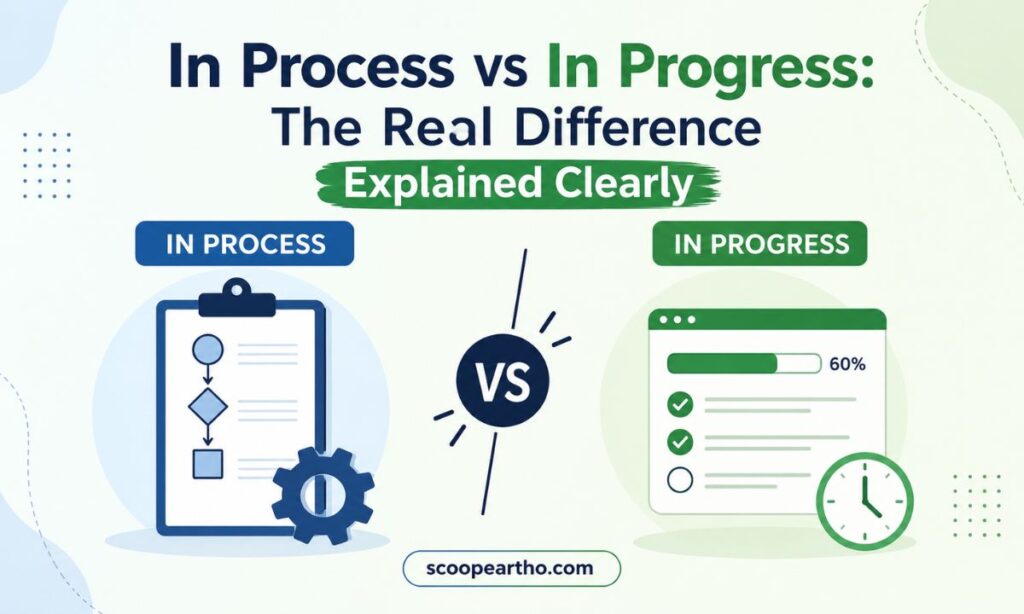
If you have ever paused mid email wondering whether to type “your order is in process” or “your order is in progress,” you are not alone. This single word swap trips up writers, customer support teams, and even native English speakers every single day. The debate of In Process vs In Progress feels small on the surface, but it actually changes how professional, accurate, and trustworthy your writing sounds.
In this guide, we will break down In Process vs In Progress in plain language, show you real examples, compare them side by side, and give you a simple test so you never second guess yourself again.
Why “In Process” and “In Progress” Confuse So Many People
The confusion around In Process vs In Progress exists because both phrases describe something that has started but has not finished yet. They look almost identical, they sound similar when spoken quickly, and dictionaries often define them in overlapping terms.
But language is rarely that simple. One phrase grew out of formal systems and procedures. The other grew out of visible, human effort. Once you understand that split, most of the confusion around In Process vs In Progress disappears.
Here are the main reasons people mix them up:
- Both phrases use the word “in” to signal something ongoing
- Process and progress share a similar root and similar spelling
- Many industries use them loosely, without following a strict rule
- Spellcheckers and grammar tools rarely flag either one as wrong
READ MORE: On a Call vs In a Call: Mastering the Subtle Differences in English Conversations
In process vs in progress cpu
In computing, “in process” has a technical meaning that has nothing to do with grammar preference. A process, in CPU terms, is a program that is currently loaded and running in memory. When a task is described as “in process” on a CPU or operating system level, it usually refers to an active process ID that the processor is executing or scheduling.
“In progress,” on the other hand, is used more casually in tech contexts, such as a file upload that is in progress or a software build that is in progress. So when someone asks about In Process vs In Progress cpu usage, the distinction usually comes down to this: “in process” refers to a formal system state (a running process thread), while “in progress” simply describes an activity that has not finished, without any technical implication.
The Quick Answer (For Readers Who Want It Fast)
If you only remember one thing about In Process vs In Progress, remember this:
- In process means something is moving through a defined system, workflow, or set of steps.
- In progress means something is actively happening or being worked on right now.
That is the core of In Process vs In Progress. Everything else in this article simply builds on that foundation.
What “In Process” Actually Means
“In process” describes something that exists inside a structured sequence. It does not always mean a person is physically working on it at this exact moment. Instead, it suggests the item is somewhere within a workflow, moving from one stage to the next.
This is why “in process” shows up so often in business, manufacturing, banking, and legal writing. These fields rely on structured stages, approvals, and checkpoints rather than constant hands on activity.
Key Characteristics of “In Process”
- Refers to a formal system, procedure, or pipeline
- Often used when no single person is actively handling the task
- Common in operations, logistics, HR, and administrative writing
- Feels more structured, procedural, and slightly formal
A Helpful Analogy
Think of “in process” like a letter moving through a postal sorting facility. Nobody is holding that letter in their hands every second, yet it is still moving through a defined system toward delivery. That is the essence of “in process” inside the In Process vs In Progress comparison.
In process or in progress synonym
Looking for a synonym is another way people try to resolve the In Process vs In Progress debate. For “in process,” close synonyms include “underway,” “being processed,” “in the pipeline,” or “in the works” when referring to a system or procedure. For “in progress,” synonyms include “ongoing,” “underway,” “being worked on,” or “currently happening.”
Notice that “underway” can technically describe both, which is exactly why so many writers reach for it when they are unsure. When in doubt, choosing a neutral synonym like “underway” can help you avoid misusing either phrase in formal writing.
Correct and Real Examples of “In Process”
- Your job application is in process.
- The refund request is in process.
- The order is in process at the warehouse.
- Your payment is in process at the bank.
- The visa request is in process.
Why These Examples Work
Each of these examples involves a formal system: a hiring pipeline, a payment gateway, a warehouse workflow, or a government office. Nobody needs to be actively touching the task at that exact second for “in process” to be accurate. This is the heart of correct usage in the In Process vs In Progress discussion.
When “In Process” Sounds Wrong
Despite being correct in many settings, “in process” often feels stiff or even incorrect in casual writing. Saying “my homework is in process” or “the book writing is in process” sounds unnatural to most native speakers, because these tasks involve visible, personal effort rather than a formal system.
In these situations, “in progress” is almost always the better fit, which is another reason the In Process vs In Progress question keeps coming up in everyday conversation.
What “In Progress” Actually Means
“In progress” describes ongoing action. Something has started, and real effort is currently happening. This phrase feels human because it highlights movement, activity, and visible work rather than a background system.
Core Features of “In Progress”
- Describes an activity happening right now
- Implies visible human effort or active development
- Common in everyday conversation, project management, and creative work
- Feels natural, friendly, and easy to understand
Correct and Real Examples of “In Progress”
- The construction is in progress.
- Sorry, the meeting is in progress right now.
- Road construction is in progress near the highway.
- The repair work is in progress.
- His dissertation is still in progress.
Why “In Progress” Works So Well
Every example above involves visible, active effort. A meeting is happening. Workers are repairing something. A student is writing. There is no ambiguity, which is exactly why “in progress” wins so often in the In Process vs In Progress comparison, especially in casual and everyday English.
In Process vs. In Progress: Side-by-Side Comparison
| Feature | In Process | In Progress |
| Core meaning | Moving through a formal system or procedure | Actively happening right now |
| Tone | Formal, procedural | Natural, conversational |
| Common industries | Banking, HR, manufacturing, legal | Everyday work, project management, creative fields |
| Human involvement | Not always required | Usually implies active human effort |
| Popularity in modern English | Less common | Far more common |
| Example | Your refund is in process | Your report is in progress |
This table sums up most of the In Process vs In Progress debate in one glance.
Which One Sounds More Natural in Everyday English?
In real conversation, “in progress” wins by a wide margin. People do not naturally think in workflows; they think in actions. Saying “I’m working on it” naturally becomes “It’s in progress,” not “It’s in process.”
Historical usage data backs this up too. <cite index=”3-1″>Looking at usage across English-speaking communities since 1800, in progress has clearly been the preferred version of this phrase for nearly two centuries</cite>. So unless you have a specific procedural reason to use “in process,” sticking with “in progress” in daily writing is the safer, more familiar choice.
Industry-Specific Usage That Actually Matters
Understanding In Process vs In Progress becomes far more practical once you see how different industries actually use these phrases.
Business and Corporate Communication
Corporate emails often use “in process” when referring to internal approvals, budget reviews, or procurement steps that move through several departments. “In progress” is used more for active projects, campaigns, or deliverables that a specific team is currently building.
Legal and Government Contexts
Legal and government writing leans heavily on “in process” because it accurately reflects paperwork, applications, and cases moving through official, multi step procedures. Terms like “case in process” or “application in process” are extremely common in this space.
Customer Support and Service Emails
Customer support teams often choose between these two phrases without realizing the impact. Telling a customer “your request is in progress” implies someone is actively working on it right now. If that is not true, and the request is simply sitting in a queue or automated pipeline, “in process” is the more honest and accurate phrase.
Common Mistakes People Make
Treating Them as Fully Interchangeable
Many writers assume In Process vs In Progress is just a stylistic choice with zero difference in meaning. While both are grammatically valid in many contexts, using the wrong one can create a misleading impression, especially in customer facing writing.
Overusing “In Process” to Sound Professional
Some writers overuse “in process” because it feels more formal or corporate. This backfires when the sentence describes obvious human effort, making the writing feel cold or robotic instead of professional.
Using “In Process” in Casual Writing
Saying things like “dinner is in process” or “my workout is in process” sounds awkward to most readers. Casual, personal activities almost always call for “in progress” instead.
In Progress or in Process
When you are genuinely stuck between in progress or in process, ask yourself a simple question: is a person actively doing the work right now, or is the item simply moving through a system? If a person is actively involved, choose “in progress.” If it is moving through an automated or procedural system, “in process” is usually more accurate.
The Grammar Behind the Phrases (Without the Lecture)
Both “in process” and “in progress” are prepositional phrases functioning as adjectives, usually placed after a linking verb like “is” or “was.” Grammatically, both are valid constructions, and neither phrase requires a hyphen when used this way.
The hyphenated form “in-progress” only appears when the phrase functions as a compound modifier directly before a noun, such as an “in-progress project.” Outside of that specific structure, no hyphen is needed in the In Process vs In Progress comparison.
A Simple Test to Choose the Right One
Whenever you are unsure, run the sentence through this quick mental test. It resolves almost every instance of In Process vs In Progress you will ever encounter.
Quick Decision Checklist
- Is a specific person actively working on this right now? If yes, use “in progress.”
- Is the item moving through a formal system, pipeline, or set of approvals? If yes, use “in process.”
- Is the context casual, personal, or creative? Choose “in progress.”
- Is the context legal, administrative, or procedural? Choose “in process.”
- Still unsure? Default to “in progress,” since it is the more widely accepted and understood option.
SEO and Writing Tip: Which Phrase Should You Use Online?
For website copy, blog posts, and marketing content, “in progress” is generally the smarter default. It feels more human, matches how people naturally search and speak, and performs better for readability.
Smart SEO Usage
- Use “in progress” for user facing content like status updates, project pages, and blog posts
- Use “in process” for backend, legal, or procedural language such as order tracking or application systems
- Avoid keyword stuffing either phrase; write naturally and let context decide
- Match the phrase to your audience’s expectations, not just search volume
Work in process or in progress
In manufacturing, finance, and accounting, “work in process” is an established technical term referring to partially completed goods still moving through production. It is not interchangeable with “work in progress” in this specific context, since “work in process” refers to inventory sitting between raw materials and finished goods.
“Work in progress” is the broader, more general phrase used in creative fields, project management, and everyday conversation to describe anything unfinished. So when comparing work in process or in progress, industry context decides which term is technically correct.
Real-World Case Study: A Job Application Status Page
A hiring platform once tested both phrases on its applicant status page to see which reduced confusion. The results highlight exactly why In Process vs In Progress matters in real business writing.
Bad Copy
“Your application is in progress.” This wording implied a recruiter was actively reviewing the resume at that exact moment, which was not true. Applicants called and emailed asking for updates, assuming someone was working on their file in real time.
Better Copy
“Your application is in process.” This version accurately reflected that the application was moving through an automated screening system, not sitting on a recruiter’s desk. Support inquiries dropped noticeably after the wording changed, simply because the phrase matched reality.
A Quote Worth Remembering
Good writing does not just sound right, it tells the truth clearly. That single idea explains almost everything about choosing correctly between these two phrases.
Final Rule You’ll Never Forget
If a person is actively doing the work right now, say “in progress.” If the task is quietly moving through a system, procedure, or pipeline, say “in process.” That is the entire In Process vs In Progress rule in one sentence.
Conclusion
The debate of In Process vs In Progress is not about grammar nitpicking, it is about communicating clearly and accurately. “In progress” highlights visible human effort and dominates everyday English, while “in process” points to structured systems and procedures common in business, legal, and administrative writing.
Once you internalize this simple distinction, you will never hesitate over In Process vs In Progress again. Use the checklist, match the phrase to the context, and your writing will instantly sound more precise, professional, and human.

A passionate grammar enthusiast with over 4 years of experience in English writing and content creation. Through Scoopeartho, he simplifies grammar rules and common English mistakes with clear and easy-to-understand guides for readers worldwide.