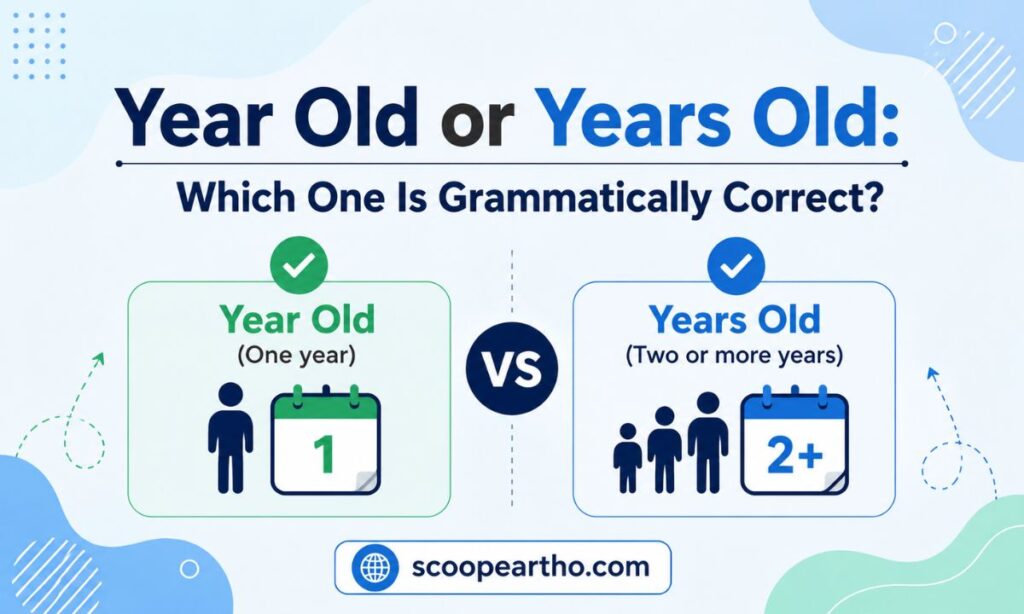
If you have ever paused mid sentence wondering whether to write “a 10 year old boy” or “a 10-year-old boy,” you are not alone. The debate over Year Old or Years Old trips up students, bloggers, journalists, and even seasoned editors. The good news is that the rule is simple once you understand how English handles compound adjectives.
In this guide, we will break down exactly when to use “year old” and when to use “years old,” explain the hyphenation rules behind Year Old or Years Old, and give you real examples you can apply immediately in your own writing.
Understanding Why ‘Year Old’ vs. ‘Years Old’ Causes Confusion
The confusion around Year Old or Years Old exists because both phrases sound identical in speech. English pronunciation does not reveal punctuation, so when people move from talking to typing, they often guess.
Another reason Year Old or Years Old confuses so many writers is that the correct form depends entirely on sentence position, not on the actual age being described. A one year old and a hundred year old follow the exact same grammar pattern, which surprises many learners who assume plural numbers always need “years.”
Add in autocorrect tools that inconsistently flag hyphens, and it is easy to see why so many people search for clarity on Year Old or Years Old every single day.
READ MORE: In Process vs In Progress: The Real Difference Explained Clearly
Year old or years old abbreviation
When space is limited, such as in headlines, resumes, or text messages, writers often shorten age expressions. The most common abbreviated form is simply the numeral plus “yo” (for example, “25 yo”) or “y/o.” However, these shorthand versions are considered informal and are rarely appropriate in professional writing.
For formal contexts, there is no true abbreviation for Year Old or Years Old. Style guides such as AP and Chicago recommend writing out “year old” or “years old” in full, using numerals for the age itself rather than spelling out numbers.
Grammar Basics: The Structure Behind ‘Year Old’ and ‘Years Old’
To understand Year Old or Years Old, it helps to know two grammar terms:
- Compound adjective: two or more words joined together to describe a noun, such as “well known author” written as “well-known author.”
- Predicate adjective: a word or phrase that follows a linking verb (like “is” or “are”) and describes the subject.
When “year old” sits before a noun, it behaves as a compound adjective and takes a hyphen. When “years old” follows a linking verb, it behaves as a predicate adjective and needs no hyphen. This single distinction resolves almost every question about Year Old or Years Old.
When to Use ‘Year Old’ (Hyphenated and Singular)
Use the singular, hyphenated form “year old” whenever the age phrase comes directly before the noun it modifies. This is the version of Year Old or Years Old that acts like one combined adjective.
Examples:
- A 7-year-old girl solved the puzzle.
- The shelter rescued a 2-year-old dog.
- Scientists studied a 150-year-old tree.
Notice that “year” stays singular even when the number is large. That is because the entire phrase functions as a single descriptive unit, not as a plural noun.
Quick Grammar Tip:
If you can swap the age phrase for a single word adjective, like “young” or “old,” and the sentence still makes sense, you likely need the hyphenated form.
Year old or years old grammar
The underlying grammar rule for Year Old or Years Old comes from how English treats compound modifiers. Compound adjectives placed before a noun are joined with hyphens and kept in their singular form, regardless of the number involved. This is the same pattern seen in phrases like “five-star hotel” or “three-week vacation.”
Once a phrase like “year old” turns into an adjective, English grammar no longer treats “year” as a countable noun that needs pluralizing. Instead, the whole hyphenated cluster acts as one word.
When to Use ‘Years Old’ (Plural, No Hyphen)
Use the plural, unhyphenated form “years old” when the age phrase comes after the noun or after a linking verb, rather than before a noun. In this position, “years” functions as a true plural noun, so no hyphen is needed.
Examples:
- My grandfather is 80 years old.
- The museum is 50 years old.
- She turned 21 years old last week.
Here, the age is simply stating a fact about the subject rather than modifying an upcoming noun.
The Role of Hyphens in Age Descriptions
Hyphens exist to prevent confusion. Without them, a sentence like “a man eating shark” could be misread as a description of a shark that eats men, rather than a large predatory shark. The same logic applies to Year Old or Years Old.
Why Hyphens Matter:
- They group words that function as a single idea.
- They stop readers from misparsing a sentence on first read.
- They signal to search engines and editors that the writer understands standard English mechanics.
Style Guide Consensus on Hyphenation
Major style guides largely agree on how to handle Year Old or Years Old, though small differences exist in whether numbers are spelled out.
| Style Guide | Number Format | Hyphenation Rule |
| AP Style | Always use numerals (5-year-old) | Hyphenate before a noun |
| Chicago Manual of Style | Spell out one through nine | Hyphenate before a noun |
| APA Style | Always use numerals | Hyphenate before a noun |
| MLA Style | Spell out simple numbers | Hyphenate before a noun |
Across every major authority, the placement rule for Year Old or Years Old stays consistent. Only the numeral versus spelled out number choice changes.
When Hyphenation Is Not Needed
Hyphens are dropped whenever the age phrase functions as a predicate rather than a modifier. This happens most often right after a form of the verb “to be.”
- He is 40 years old. (no hyphen)
- The bridge is 90 years old. (no hyphen)
- They are three years old. (no hyphen)
If you find yourself unsure, try reading the sentence aloud and checking whether a noun immediately follows the age phrase. If nothing follows, skip the hyphen.
12-year-old or 12 years old
This exact phrase is one of the most searched variations of Year Old or Years Old, and the rule works the same way here.
- Write “12-year-old” when a noun comes next: The 12-year-old student won the science fair.
- Write “12 years old” when stating age directly: The student is 12 years old.
- Write “12-year-old” alone as a noun substitute: The 12-year-old loves science.
Common Mistakes and How to Avoid Them
Even experienced writers slip up on Year Old or Years Old. Here are the three most frequent errors.
Mistake 1: Pluralizing “Year” in Hyphenated Form
Incorrect: a five-years-old boy Correct: a five-year-old boy
Compound adjectives never pluralize their internal parts.
Mistake 2: Forgetting the Hyphen
Incorrect: a 10 year old boy Correct: a 10-year-old boy
Without hyphens, the sentence briefly reads as three separate words instead of one descriptive unit.
Mistake 3: Mixing the Two Structures
Incorrect: She is a 30-years-old woman. Correct: She is a 30-year-old woman.
Mixing plural “years” with a hyphen is one of the most common Year Old or Years Old errors online.
Mini Reference Table
| Sentence Pattern | Correct Form | Example |
| Before a noun | year-old (hyphenated, singular) | a 9-year-old cat |
| After a linking verb | years old (no hyphen, plural) | The cat is 9 years old |
| Used as a noun | year-old (hyphenated) | She is a 9-year-old |
How to Apply These Rules in Everyday Writing
Understanding Year Old or Years Old in theory is one thing. Applying it consistently across different writing contexts is another.
1. In Resumes or Bios
Keep age references formal and precise, such as “a 28-year-old marketing specialist with five years of experience.” Hyphenation shows attention to detail, something recruiters notice.
2. In Journalism
News style consistently favors numerals with hyphens before a noun, such as “the 34-year-old suspect,” while stating age plainly afterward, such as “the suspect, 34 years old, was arrested.”
3. In Everyday Conversation
Casual writing, like texts or social posts, often skips hyphens entirely. This is acceptable informally, but it is still worth knowing the correct Year Old or Years Old rule for anything formal.
4. In Fiction Writing
Fiction relies on the same rule but benefits from spelled out numbers for readability, such as “the seven-year-old girl” rather than “the 7-year-old girl,” depending on your chosen style guide.
Quick Recap: ‘Year Old’ vs. ‘Years Old’ at a Glance
- Before a noun: hyphenate and keep “year” singular.
- After a linking verb: no hyphen, use plural “years.”
- As a standalone noun: hyphenate, such as “a 20-year-old.”
- Never mix plural “years” with a hyphenated structure.
This simple checklist resolves the vast majority of Year Old or Years Old confusion in everyday writing.
Real-Life Case Study: Why Context Matters

Grammar rules feel abstract until you see them affect real communication. Consider a newsroom editing two versions of the same story about a toddler.
Case Study: Media Headlines
Headline A: “3-Year-Old Rescued From Pool” uses the hyphenated form because “year-old” modifies the implied noun “child.”
Headline B: “Toddler Rescued From Pool, 3 Years Old” states the age after the noun, so no hyphen is used.
Both headlines are grammatically correct, but they demonstrate how sentence structure, not personal preference, decides the correct version of Year Old or Years Old.
Years Old
Standing alone, “years old” is the plural, unhyphenated form used whenever you are stating someone’s or something’s age directly. It always follows a linking verb such as is, are, was, or were, and it should never appear with a hyphen. Keeping this single fact in mind eliminates most Year Old or Years Old mistakes.
Expert Insight
Professional editors and linguists consistently point to sentence position as the deciding factor in Year Old or Years Old, rather than the size of the number involved. According to language experts, compound adjectives behave like single units before a noun, while the same words revert to ordinary plural nouns once they follow a verb. This structural explanation is why the rule stays logical even for very large numbers, such as a “200 year old building,” which still uses the hyphenated singular form.
Common Variations and Edge Cases
Not every age related phrase fits neatly into the standard Year Old or Years Old pattern. A few edge cases deserve extra attention.
Using “Year-Old” Without Numbers
Sometimes writers use “year-old” with a spelled out age or even without a specific number, such as “a year-old rumor” or “day-old bread.” The same hyphenation logic applies regardless of whether a numeral or word is used.
Using “Old” Alone
When no specific number is given, writers often drop “year” entirely and use “old” by itself, such as “an old car” or “she looks older than she is.” This avoids the Year Old or Years Old question altogether by removing the numeric element.
Using “Aged” as a Replacement
Formal and legal writing sometimes replaces the phrase with “aged,” as in “a woman aged 45” or “children aged 6 to 12.” This construction sidesteps hyphenation debates while remaining precise and professional.
Related Grammar Guides to Deepen Your Understanding
- Hyphenation rules for compound adjectives
- When to spell out numbers versus using numerals
- AP Style versus Chicago Style comparison guides
- Common punctuation mistakes in professional writing
Conclusion
The debate over Year Old or Years Old comes down to one simple question: does the phrase come before a noun, or does it follow a linking verb? Once you can answer that, hyphenation and pluralization fall into place naturally.
Keep this rule in mind: hyphenate and stay singular before a noun, drop the hyphen and use the plural after a verb. With that single principle, you will never second guess Year Old or Years Old again, whether you are writing a resume, a news story, or a casual message to a friend.

A passionate grammar enthusiast with over 4 years of experience in English writing and content creation. Through Scoopeartho, he simplifies grammar rules and common English mistakes with clear and easy-to-understand guides for readers worldwide.