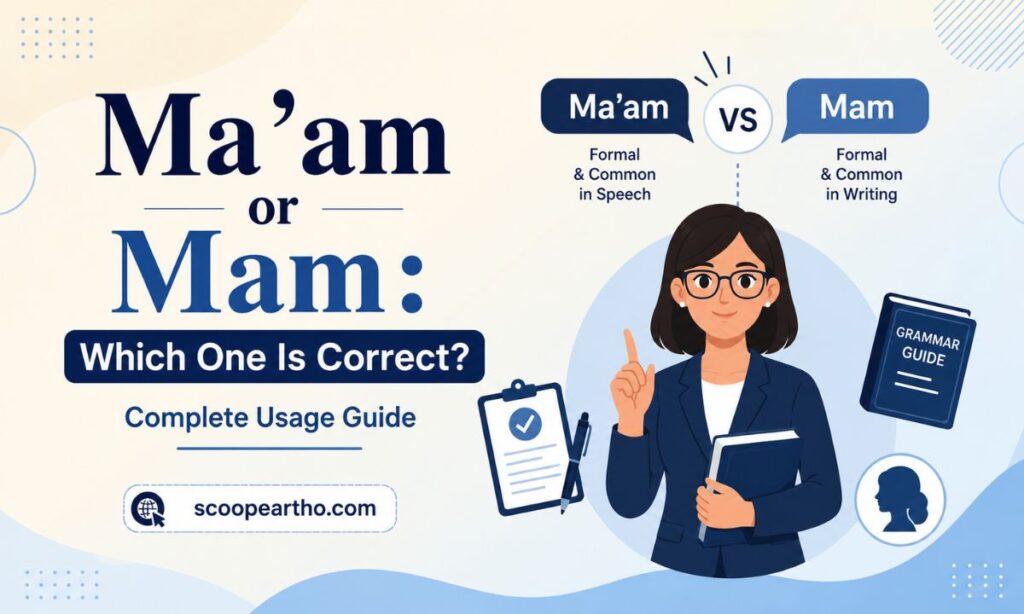
If you have ever paused mid sentence wondering whether to type “ma’am” or “mam,” you are not alone. This tiny spelling choice confuses students, customer service agents, and even native English speakers every single day. The words sound almost identical when spoken, yet only one of them is correct in formal English writing.
In this guide, you will get a clear, no confusion answer to the Ma’am or Mam debate. We will look at where the word came from, how British English and American English treat it differently, and how to avoid the small mistakes that make writers look unprofessional. By the end, you will never have to second guess your spelling again.
Ma’am or Mam – Quick Answer
Let’s settle the Ma’am or Mam question right away.
Ma’am is the correct spelling in standard, formal English. It is used as a polite way to address a woman, especially one whose name you do not know.
Mam is informal or regional. It is common in parts of the United Kingdom and Ireland, where it usually means “mother,” not a polite title for a stranger.
So when someone asks Ma’am or Mam, the safe and professional choice is almost always ma’am. Save mam for casual conversation about your mother, and never use it as a substitute for a respectful greeting in an email, exam, or customer service message.
| Situation | Correct Choice |
| Addressing a woman politely | Ma’am |
| Talking about your mother (UK/Ireland) | Mam |
| Formal emails and letters | Ma’am or Madam |
| Customer service scripts | Ma’am |
The Origin of Ma’am or Mam
To really understand the Ma’am or Mam puzzle, it helps to look at history.
The word traces back to the French phrase “ma dame,” meaning “my lady.” English speakers adopted it as “madam” and used it as a respectful title for centuries. Over time, in fast, everyday speech, people began dropping letters to make the word quicker to say.
That shortened, spoken version eventually became ma’am, with an apostrophe standing in for the missing letters “d” and “a.” Because it is a contraction of madam, the apostrophe is not optional. It signals that something has been removed, the same way “don’t” signals a missing “o.”
Mam developed separately. It grew out of regional pronunciation, particularly in Northern England, Ireland, and Wales, where it became an affectionate term for “mother.” It was never meant to replace the formal address at all, which is exactly why the Ma’am or Mam mix up happens so often today.
READ MORE: Year Old or Years Old: Which One Is Grammatically Correct?
British English vs American English Spelling
One reason the Ma’am or Mam confusion spreads so widely is that people assume it is a British versus American spelling difference, like “colour” versus “color.” That assumption is not accurate.
Here is what actually happens on each side of the Atlantic:
- American English: Ma’am is used constantly, in speech and in writing. It appears in customer service, schools, the military, and everyday polite conversation, especially in the Southern United States.
- British English: Ma’am still exists and is used formally, for example when addressing the Queen or King’s representatives, police officers, or senior officials. However, mam is also common in certain UK regions, but only when referring to one’s mother, not as a polite title.
So the real difference in the Ma’am or Mam debate is not about spelling variation between countries. It is about context and regional dialect. Both American and British English accept ma’am as the correct polite address. Mam simply carries a completely different meaning in casual British and Irish speech.
Ma’am or Mam for Teacher
Students often ask whether it is correct to call a female teacher “mam” instead of “ma’am.” This is one of the most searched versions of the Ma’am or Mam question, especially among students in Asia and other regions where English is a second language.
The answer is straightforward:
- The grammatically correct spelling when addressing a teacher is ma’am.
- Writing “mam” in an email, assignment, or classroom message is technically incorrect, even though it is widely used informally in some countries.
- Many teachers will not mind the shorter spelling in casual conversation, but for formal writing, exams, and professional emails, ma’am is the version that follows standard English rules.
If you want to make a strong impression in written communication, always default to ma’am when addressing a teacher, professor, or any woman in a position of authority.
Which Spelling Should You Use?
Choosing between Ma’am or Mam really comes down to formality and audience. Use this simple checklist:
- Writing a formal email or letter? Use ma’am.
- Speaking to a customer, student, or stranger politely? Use ma’am.
- Talking casually about your mother in UK or Irish English? Mam is acceptable.
- Writing academic papers, business documents, or professional messages? Always use ma’am.
- Unsure which one fits? Default to ma’am. It is rarely wrong and always polite.
As a general rule, mam should almost never appear in place of a respectful title. If in doubt, ma’am is the safer and more universally accepted spelling.
Common Mistakes with Ma’am or Mam
Even experienced writers slip up on this word. Here are the most frequent errors people make in the Ma’am or Mam debate:
- Dropping the apostrophe: Writing “maam” without the apostrophe looks incorrect and unpolished.
- Using “m’am”: This is a common typo. It removes the wrong letter and is not a recognized spelling.
- Confusing it with “mam” meaning mother: Using mam to address a stranger or customer sounds informal and can come across as careless in professional writing.
- Inconsistent capitalization: Capitalize “Ma’am” only at the start of a sentence or in direct address at the beginning of dialogue; otherwise, keep it lowercase.
- Overusing it in casual writing: While polite, repeating ma’am too often in an email can sound stiff. Balance politeness with natural tone.
Avoiding these mistakes instantly improves the professionalism of your writing.
Correct Spelling of Ma’am
Since so many people search for the correct spelling of ma’am, let’s confirm it clearly.
The correct spelling is: m a apostrophe a m, written as “ma’am.”
It is not:
- Maam (missing apostrophe)
- M’am (apostrophe in the wrong place)
- Mam (different word entirely, referring to mother in British and Irish English)
Remember that ma’am is a contraction of madam, so the apostrophe replaces the letters that were dropped. This single detail is what most spellcheckers and grammar tools will flag if you get it wrong, and it is the central point behind every Ma’am or Mam search query online.
Ma’am or Mam in Everyday Examples
Seeing the word in context makes the Ma’am or Mam rule much easier to remember. Here are some real world examples:
Customer service:
- “Good afternoon, ma’am. How can I help you today?”
- “Thank you for your patience, ma’am.”
Formal email:
- “Dear Ma’am, I am writing to follow up on our previous conversation.”
Everyday conversation:
- “Excuse me, ma’am, you dropped your scarf.”
- “Yes, ma’am, I will send that file right away.”
Regional use of mam (referring to mother):
- “My mam always told me to be polite.”
- “I’m visiting my mam this weekend.”
Notice how ma’am always signals respect toward someone whose name is unknown, while mam is reserved for talking about one’s own mother in specific English dialects.
Ma’am or Mam – Google Trends and Usage Data
Search interest around Ma’am or Mam has grown steadily as more people write professionally in English across customer service, education, and digital communication. A few patterns stand out:
- Searches for “ma’am or mam” spike in regions where English is a second language, particularly in South Asia.
- “Ma’am” dominates search volume in the United States, especially tied to customer service and military contexts.
- “Mam” search interest is highest in the United Kingdom and Ireland, almost always connected to the word’s meaning of mother rather than formal address.
- Interest in correct spelling guides tends to rise around the start of school terms and during professional email etiquette searches.
This data confirms what grammar experts already know: the Ma’am or Mam question is really two separate words serving two very different purposes, and confusion happens mainly because they sound alike, not because they mean the same thing.
Ma’am Pronunciation
Pronunciation is actually where most of the Ma’am or Mam confusion begins.
Ma’am is pronounced /mæm/, rhyming with “jam” or “ham.” It is a single syllable word, spoken quickly and without stress on any particular letter.
Mam is pronounced almost identically, also as /mæm/, which is exactly why so many people assume the spellings are interchangeable. The pronunciation match is the biggest reason writers type mam when they actually mean the polite, formal ma’am.
Since sound alone cannot tell you which spelling to use, the safest approach is to think about meaning and context every time you write the word, not just how it sounds when spoken aloud.
Ma’am vs Mam: Comparison Table
Here is a side by side breakdown to settle the Ma’am or Mam comparison once and for all.
| Feature | Ma’am | Mam |
| Meaning | Polite title for a woman | Informal word for mother |
| Origin | Contraction of madam | Regional dialect form |
| Apostrophe | Yes, required | No apostrophe |
| Formality | Formal and respectful | Casual and familiar |
| Common regions | United States, formal British use | UK, Ireland |
| Used in emails | Yes | Rarely, only informal context |
| Used for teachers/strangers | Yes | No |
| Pronunciation | /mæm/ | /mæm/ |
This table makes the Ma’am or Mam distinction easy to reference whenever you are unsure which spelling fits your writing.
Frequently Asked Questions
Is mam correct English? It is correct only when referring to one’s mother in British or Irish dialects, not as a polite title.
Why does ma’am have an apostrophe? Because it is a contraction of madam, and the apostrophe replaces the missing letters.
Can I use mam for a teacher? Grammatically, no. Ma’am is the correct spelling for formal address.
Is m’am ever correct? No, m’am is a common typo and is not accepted in standard English.
Do British and American English spell it differently? No, both use ma’am for polite address; the difference lies in regional word usage, not spelling rules.
Should I use ma’am in professional emails? Yes, ma’am is appropriate and widely accepted in professional writing.
Conclusion
The Ma’am or Mam debate ultimately comes down to one simple rule: ma’am is the correct spelling for polite, formal address, while mam is a regional term meaning mother, mostly used in the UK and Ireland. They may sound the same out loud, but their meanings and contexts are completely different.
Whenever you are addressing a woman respectfully, whether in an email, a classroom, or a customer service interaction, choose ma’am. Reserve mam only for casual conversations about your own mother, and never as a substitute for a respectful greeting.
With this guide, the Ma’am or Mam confusion should be fully resolved. Keep this comparison handy, and you will never second guess your spelling again.

A passionate grammar enthusiast with over 4 years of experience in English writing and content creation. Through Scoopeartho, he simplifies grammar rules and common English mistakes with clear and easy-to-understand guides for readers worldwide.