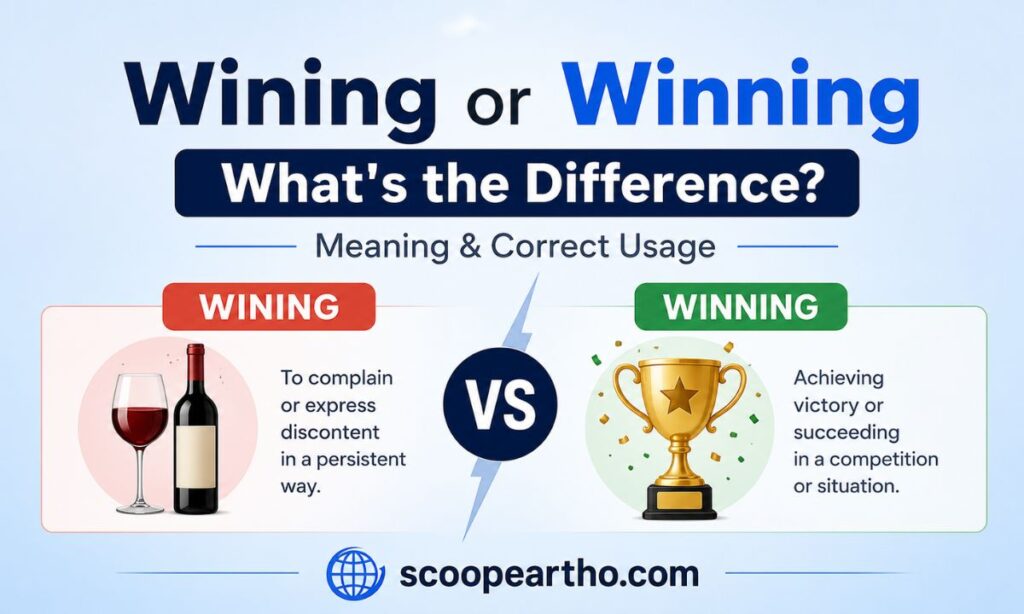
Have you ever typed a sentence, stared at it for a second, and thought “wait, is that spelled right”? If the word in question was wining or winning, you are not alone. These two words look almost identical, sound almost identical when spoken quickly, and yet they mean completely different things.
This confusion between wining or winning shows up everywhere. It appears in text messages, work emails, social media captions, and even in published articles. One extra letter changes the entire meaning of a sentence, and that small slip can make your writing look careless.
In this guide, we will settle the wining or winning debate once and for all. You will learn the meaning of each word, where they come from, how British and American English treat them, and how to avoid mixing them up again.
Wining or Winning – Quick Answer
Let’s clear this up right away. Winning means achieving success, victory, or a desired result. Wining, on the other hand, relates to wine, usually in phrases about serving or drinking it socially.
Here is the simplest way to remember the wining or winning difference:
- Winning (two n’s) means you succeeded at something. Example: She is winning the race.
- Wining (one n) means wine is involved. Example: They spent the evening wining and dining clients.
If your sentence is about success, sports, competitions, or achievement, the correct word is always winning. If your sentence is about wine, hospitality, or entertaining guests, then wining is the word you want. Outside of the phrase “wining and dining,” wining is rarely used on its own in everyday writing.
The Origin of Wining or Winning
Understanding where these words come from makes the wining or winning mix up much easier to avoid.
Winning traces back to the Old English word winnan, which meant to labor, strive, or fight for something. Over centuries, this sense of struggle shifted toward the idea of achieving victory through effort. That is why winning today carries such a strong connection to success, competition, and reward.
Wining has a completely different background. It comes from the noun wine, which itself traces back to the Latin word vinum. When you add ing to a verb form of wine, you get wining, meaning the act of drinking or serving wine, often in a social or celebratory setting.
So although wining or winning look like they might share a root, they actually come from two unrelated word families. One is tied to effort and victory. The other is tied to grapes, fermentation, and hospitality. Once you know this, the spelling difference starts to make a lot more sense.
READ MORE: Ma’am or Mam: Which One Is Correct? Complete Usage Guide
Wining or Winning Meaning
Let’s break down the exact meaning of each term so there is no room left for confusion.
Winning is an adjective or verb form describing:
- Achieving success in a game, contest, or competition
- Gaining approval, favor, or admiration (a winning smile, a winning personality)
- Coming out on top in a negotiation, election, or argument
Wining is a verb form describing:
- Drinking wine socially
- Serving wine to guests, often as part of entertaining
- Appearing almost exclusively in the expression “wining and dining”
Here are a few side by side examples to lock in the wining or winning meaning:
- Correct: The company is winning new contracts every quarter.
- Correct: The host was wining and dining the visiting delegates.
- Incorrect: The company is wining new contracts every quarter.
- Incorrect: The host was winning and dining the visiting delegates.
Notice how swapping just one letter completely changes what the sentence is actually saying.
British English vs American English Spelling
Many spelling debates in English come down to regional differences, think color versus colour or organize versus organise. So does the wining or winning distinction follow the same pattern? Not really.
There is no British versus American spelling variation for these two words. Both forms of English spell winning with a double n and wining with a single n, and both assign the same meanings to each word. A reader in London and a reader in New York will interpret wining or winning exactly the same way.
The only regional nuance worth mentioning is usage frequency. In both British and American English, winning is used constantly across sports, business, education, and daily conversation. Wining shows up far less often and almost always inside the set phrase “wining and dining,” which is common in both dialects when describing lavish hospitality or client entertainment.
So if you were hoping regional spelling rules might explain away a mistake, this is one case where the rule is universal. Getting wining or winning right depends purely on meaning, not geography.
Which Spelling Should You Use?
This is the practical part everyone actually wants answered. When facing the wining or winning choice in your own writing, ask yourself one question: does this sentence involve success, or does it involve wine?
| Situation | Correct Word |
| Talking about sports, games, or contests | Winning |
| Talking about business deals or negotiations | Winning |
| Talking about someone’s charm or appeal | Winning |
| Talking about serving or drinking wine | Wining |
| Talking about entertaining clients with food and drink | Wining |
A simple memory trick many writers use is this: success needs two n’s, just like it needs extra effort. If you picture double n as double effort, the correct spelling becomes much easier to recall under pressure.
For the overwhelming majority of everyday writing, winning is the word you need. Wining exists, and it is grammatically correct, but its use is narrow and mostly limited to descriptions of hospitality.
Wining or Winning Synonyms
Expanding your vocabulary around wining or winning can help you avoid repetition and pick the most precise word for your sentence.
Synonyms for winning include:
- Succeeding
- Triumphing
- Prevailing
- Achieving victory
- Coming out on top
- Claiming success
Synonyms and related terms for wining include:
- Wine and dine
- Entertaining with drinks
- Hosting over wine
- Socializing with wine
Choosing the right synonym depends entirely on context, just like choosing between wining or winning itself. If you are describing a sports outcome, triumphing or prevailing works well. If you are describing a business dinner involving fine wine, wine and dine fits naturally.
Common Mistakes with Wining or Winning
Even confident writers slip up occasionally with wining or winning. Here are the most frequent errors people make:
- Dropping a letter by accident. Fast typing often causes people to drop one n from winning, accidentally producing wining without realizing the meaning has changed.
- Trusting autocorrect blindly. Since wining is a legitimate word, spellcheck tools will not flag it as an error, even when winning was the intended word.
- Mishearing spoken English. In casual speech, the difference between wining or winning can blur together, leading people to misspell the word they meant to write.
- Overusing wining outside its normal context. Some writers use wining to describe general success, which is incorrect. Wining should stay connected to wine specifically.
- Assuming regional spelling differences exist. As covered earlier, there is no British versus American variation here, so blaming regional spelling will not fix this particular mistake.
Reading your sentence back slowly and asking whether wine is genuinely part of the meaning is the fastest way to catch a wining or winning slip before you hit publish or send.
Wining or Winning in Everyday Examples
Seeing the wining or winning distinction used in realistic sentences makes it easier to apply correctly in your own writing.
Examples using winning:
- Her proposal is winning support from the entire board.
- The underdog team kept winning against tougher opponents.
- He has a winning personality that puts people at ease immediately.
- Their marketing strategy is winning over new customers every month.
Examples using wining:
- The sales team spent the weekend wining and dining potential investors.
- She enjoys wining and dining friends at her favorite restaurant.
- The resort is known for wining guests with a curated selection from the region.
Notice that wining almost never appears alone. It typically shows up paired with dining, which signals to readers that the sentence is about hospitality rather than achievement.
Whining or Wining Dance
There is another layer of confusion worth mentioning, and it involves a third word entirely: whining. In Caribbean culture, particularly across Trinidad, Jamaica, and other islands during carnival season, wining refers to a popular dance style built around rhythmic hip and waist movement, often performed to soca or calypso music.
This dance related sense of wining is spelled with one n, matching the wine related word discussed earlier, though the two meanings come from very different contexts. Some regions and casual writers spell it whining instead, borrowing from the English word for complaining, but that spelling is technically inaccurate for the dance itself.
So to be clear:
- Wining (dance) refers to the hip rolling movement associated with Caribbean carnival culture.
- Whining (standard English) means complaining in a high pitched, irritating tone.
- Winning means achieving success or victory.
Three very different meanings, three very similar spellings. This is exactly why wining or winning, along with whining, causes so much mix up online, especially in music, dance, and pop culture writing.
Wining or Winning – Google Trends & Usage Data
Search behavior tells an interesting story about how often people actually confuse these words. Search interest around the phrase wining or winning consistently spikes because so many people are unsure which spelling applies to their sentence, rather than searching out of general curiosity.
Usage data across published writing also shows a clear pattern. Winning appears dramatically more often than wining across news articles, business content, sports coverage, and everyday communication. Wining shows up in a narrow band of contexts, mostly hospitality, travel, and lifestyle writing centered on the phrase wining and dining.
This tells us something useful. If you are ever unsure which word fits, the statistical safe bet leans heavily toward winning, since it covers a much broader range of everyday situations. Wining remains correct, but its use case is naturally limited.
Wining vs Winning: Side by Side Comparison
Here is a complete comparison table to settle the wining or winning question once and for all.
| Feature | Winning | Wining |
| Spelling | Double n | Single n |
| Word origin | Old English winnan (to strive) | Latin vinum (wine) |
| Core meaning | Achieving success or victory | Drinking or serving wine |
| Common phrase | Winning streak, winning attitude | Wining and dining |
| Frequency of use | Very common | Rare, mostly in set phrases |
| Part of speech | Verb, adjective | Verb |
| British vs American spelling | Same in both | Same in both |
| Typical context | Sports, business, competition | Hospitality, socializing |
Keeping this table in mind should make future decisions between wining or winning almost automatic.
Frequently Asked Questions
Is wining a real word? Yes, it is real, though rare, and it relates specifically to wine.
Is winning always spelled with two n’s? Yes, winning always uses a double n regardless of tense or context.
Does British English spell these words differently than American English? No, both dialects use identical spelling and meaning for wining or winning.
What does wining and dining mean? It means entertaining someone lavishly, usually with good food and wine.
Which word should I use in a sports context? Always use winning when describing sports, games, or competitions.
Conclusion
The wining or winning debate really comes down to one simple test: is your sentence about success, or is it about wine? Winning, with its double n, covers achievement, victory, competition, and charm. Wining, with a single n, stays tied to wine and hospitality, most often inside the phrase wining and dining.
There is no British versus American spelling divide here, no hidden grammar trap, just two words with different roots that happen to look alike. Now that you understand the meaning, origin, and correct usage behind wining or winning, you can write with confidence and never second guess that extra letter again.

A passionate grammar enthusiast with over 4 years of experience in English writing and content creation. Through Scoopeartho, he simplifies grammar rules and common English mistakes with clear and easy-to-understand guides for readers worldwide.